Auxiliary Equipment
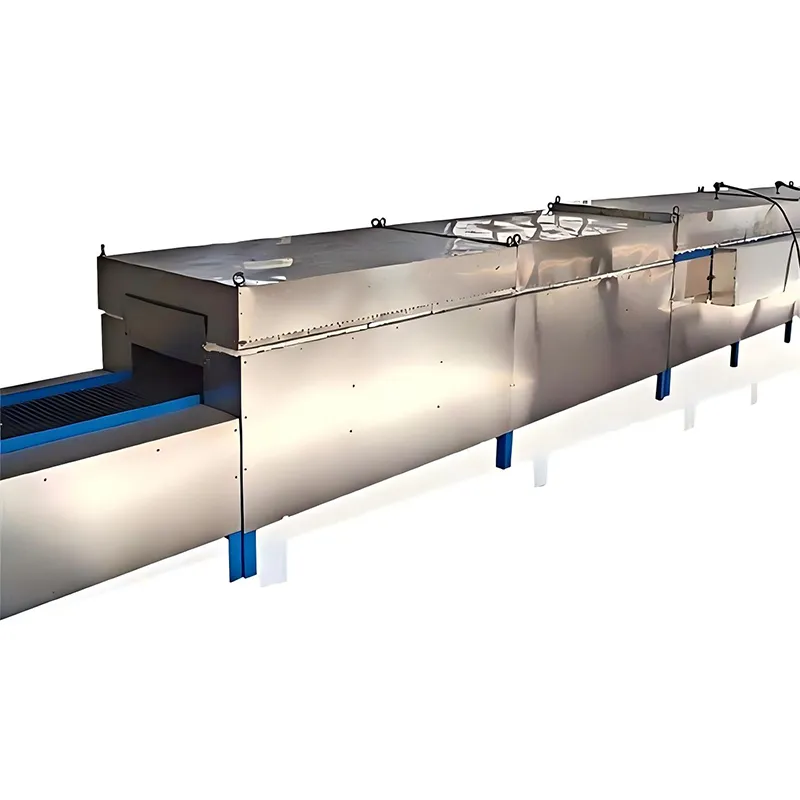
Continuous annealing oven for glass — an inline tunnel furnace that relieves internal stress with a controlled cooling gradient. Electric or gas heated.
The Tunnel Annealing Furnace is a continuous conveyor-type heat treatment furnace designed for inline annealing of glass products in high-volume production environments. Glass items enter on a conveyor belt at the hot end, pass through a precisely controlled temperature gradient, and exit fully annealed at the cool end — enabling seamless integration with upstream glass forming machines.
The tunnel design eliminates batch loading and unloading, making it ideal for continuous production lines where throughput and automation are priorities.
Also known as a continuous annealing furnace or annealing oven for glass, the machine works by relieving the internal stresses locked into glassware during forming. When molten glass is shaped, the surface cools faster than the core, freezing in uneven internal stress. Without proper annealing, that stress causes glassware to crack, chip, or shatter — sometimes spontaneously, sometimes weeks later in the field.
The furnace removes this risk in three continuous zones along the tunnel: a heating zone that brings incoming glass up to its annealing point, a soaking zone that holds it there long enough for stresses to relax uniformly, and a cooling zone that lowers the temperature gradually through the strain point so no new stress forms. Because the conveyor runs continuously, it integrates directly with upstream forming, blowing, and sealing machines.
Sea Melody builds continuous annealing furnaces for both soda-lime and borosilicate glassware, with tunnel length, width, conveyor speed, and temperature profile configured to the glass type, wall thickness, and line throughput. Heating is available in electric or gas-fired configurations, and every furnace is manufactured under our ISO 9001:2015-certified quality system. Learn more in our guide to the glass annealing process.
Both variants run at the same throughput. The choice is an energy-cost and footprint decision: the gas build draws almost no electricity but is 5.6 m longer and 1.3 t heavier; the electric build is shorter, lighter and simpler to install, at 45 kW connected load.
| Parameter | Gas-fired | Electric |
|---|---|---|
| Output Capacity | 12,000 pcs/h | 12,000 pcs/h |
| Electrical Power | 2.2 kW | 45 kW |
| Gas Consumption | 1.8 kg/h | — |
| Oxygen Consumption | 80 L/h | — |
| Overall Dimensions | 19.8 × 1.2 × 1.5 m | 14.2 × 1.2 × 1.5 m |
| Weight | 3,200 kg | 1,900 kg |
| Parameter | Value |
|---|---|
| Model | SM-J44 |
| Type | Continuous tunnel conveyor annealing furnace |
| Max Temperature | Up to ~580°C |
| Heating Zones | 3–4 temperature zones |
| Conveyor | Mesh belt, adjustable speed |
| Tunnel Width | 600–2,000 mm |
| Opening Height | 300–400 mm |
| Tunnel Length | 19.8 m gas / 14.2 m electric as standard (5–36 m available to order) |
| Control | PLC (optional) |
| Power Supply | 3-phase 380V / 50Hz |
| Construction | Insulated tunnel, energy-efficient |
Product demonstration video coming soon. Visit our YouTube channel to see Sea Melody machines in action.
Annealing and tempering are opposite heat treatments. Annealing cools glass slowly to remove internal stress, leaving it stable and easy to cut or further process — which is what a tunnel annealing furnace does. Tempering does the reverse: it cools the glass surface rapidly to lock in compressive stress for strength and impact resistance. Glassware such as bulbs, ampoules, vials, and laboratory items is annealed, not tempered — tempering is typically used for flat glass, doors, and safety glazing. Choosing the correct process matters: annealed glass can be cut and reworked, while tempered glass cannot.
Each glass type has its own annealing point — the temperature at which internal stress relaxes quickly without the glass deforming. For common soda-lime glass this is roughly 510–550°C, and for borosilicate glass around 560°C; the furnace heats slightly above this point, soaks, then cools slowly through the strain point. Because the exact profile depends on your glass composition and wall thickness, Sea Melody sets the temperature zones and conveyor speed to match your product. Contact us with your glass type for a recommended profile.
The standard catalogue builds are 19.8 m for the gas-fired furnace and 14.2 m for the electric — both rated at 12,000 pcs/h. Outside those, lengths from 5 m to 36 m are available to order: longer tunnels allow slower cooling for thicker or more stress-sensitive glass. Tell us your glass type and throughput and we will recommend a length.
A tunnel furnace provides continuous inline annealing without manual loading cycles. Products travel through the furnace on a conveyor, making it faster and more suitable for high-volume automated lines. A batch furnace is better for smaller quantities or varied product mixes.
Yes — conveyor speed is adjustable to match the output rate of upstream machines and to control the annealing time for different glass types and thicknesses.
Standard lead time is 40 working days from order confirmation, as each machine is manufactured to order. For custom or modified machines, allow approximately 60 working days. Contact us for a specific timeline based on your requirements.
Yes — Sea Melody configures tunnel length, width, temperature profile, and conveyor speed to match your specific production line. Visit our Custom Orders page.
Sea Melody provides 24/7 remote support with a 5-minute response time, online video commissioning, operation manuals, and spare parts supply. See our After-Sales Support page for full details.
This machine is designed and manufactured by Nantong Sea Melody Industrial Co., Ltd, a specialist glass machinery manufacturer based in Nantong, China, with over 24 years of experience. Sea Melody machines are currently operating in 35+ countries across pharmaceuticals, laboratory, and household glassware industries. All Sea Melody machines are produced under an ISO 9001:2015-certified quality management system. Learn more about Sea Melody →
Our team can provide full specs, custom configurations, and fast quotes. We ship to 35+ countries.
Questions about installation or ongoing maintenance? Visit our After-Sales Support page.
Need a custom configuration? Explore Custom Orders.
Want to know more about us? Learn about Sea Melody.